

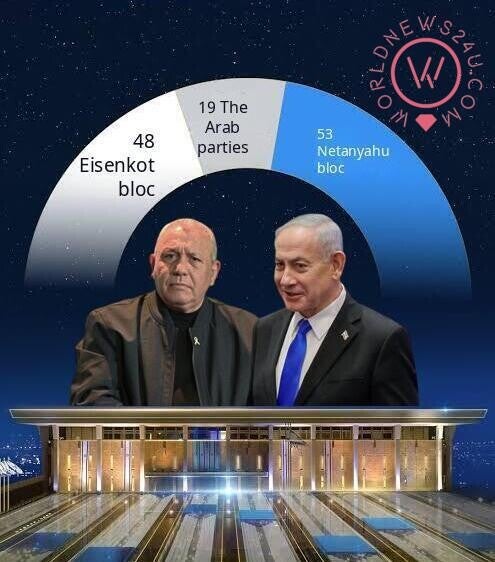
The vote counting of parliamentary elections in Israel has been completed, but after the results, the Netanyahu faction has fallen short of securing a majority in the 120-member parliament. Even the opposition has not got majority. Now will Arab parties play games? Know whose government will be formed
According to Israeli media reports, voting for the elections in Israel has concluded and the counting of all 100% of the votes has been completed. In the 120-member parliament (Knesset), Prime Minister Benjamin Netanyahu's coalition won 53 seats, while opposition parties won 48 and Arab parties won 19. Netanyahu's 'Likud' party has emerged as the largest party with 27 seats. However, neither the coalition nor the opposition camp could achieve the 61-seat mark required for a parliamentary majority, leaving the balance of power uncertain. Netanyahu has alleged vote irregularities.
Israeli elections, Netanyahu does not have majority, will Arab parties play?
Israeli police will investigate the fairness of the elections
Israeli police have promised to investigate complaints related to the fairness of the elections. Officials said three people were arrested on suspicion of bribing voters in southern Israel on election day. Subsequently, four more people were arrested for questioning in connection with the investigation. These arrests do not prove that any major fraud has taken place in the elections.
Netanyahu suspects Qatar and Turkey's role in the election
Israeli Election Results Live: According to Hebrew-language media reports, Likud suspects that the funds received by organizations involved in uniting Arab voters may have come from Qatar and Turkey. However, the letter from the head of the election committee does not name any country accused of interference, nor does it provide any details proving foreign interference.
How are elections held in Israel?
Israelis do not vote directly for the Prime Minister nor elect individual MPs from local constituencies. Instead, they cast votes for political parties or electoral lists, which present their candidates in a prearranged order. The entire country is considered to be a single constituency. Unlike systems where voters choose their representatives from different constituencies, parliamentary seats in Israel are allocated based on the national vote share that every eligible party or list has received.
Israel follows the pro rata representation' (proportional representation) system. Under this, parties in a 120-member parliament (the Knesset) receive seats roughly in proportion to their national vote share. Due to this system, many parties can reach the Parliament, due to which forming a coalition becomes most important in the process of forming the government.
Former Israeli Defense Minister warned about Arab parties
Israeli Election Results LIVE: Former Israeli Defense Minister Yoav Gallant on Thursday called for the formation of a comprehensive Jewish, Zionist national unity government following the election results. According to the Jerusalem Post, he warned against forming a coalition government that would depend on parties that he said did not recognize Israel as a nation-state of the Jewish people.
Eisenkot met with Bennett, discussed forming a new government
On Thursday, 'Yashar' party chairman Gadi Eisenkot met 'Bayachad' (Together) chairman Naftali Bennett at his home in Ra'anana, amid the Israel election results, according to 'The Times of Israel'. This meeting has taken place as part of efforts to form the next government in Israel. According to a joint statement, the two leaders discussed efforts to "form a good government in Israel as soon as possible". This meeting took place amid talks of forming an alliance. In the recent elections, no major political bloc could get the 61 seats required for a majority in Israel's 120-member parliament, the Knesset.
Netanyahu meets leader of 'Religious Zionism-Zehut' party
According to 'The Times of Israel', Hebrew media reported that following the Israel election results, Prime Minister Benjamin Netanyahu met with 'Religious Zionism-Zehut' party leader and Finance Minister Bezalel Smotrich on Thursday. The purpose of this meeting was to coordinate the future strategy after the elections.
Palestinian citizens voted in large numbers
Due to Israel's war in Gaza and Palestinian citizens of Israel came forward to vote in large numbers.
Will Netanyahu be able to form the government?
Netanyahu's 'Likud' party has emerged as the largest party, winning 27 seats, but this does not ensure that he will be able to form the next government.
How many seats are required for majority
Any political faction in Israel has 61 seats required for a parliamentary majority.
Who got how many seats
Netanyahu's faction has gained 53 seats, while the opposition has gained 48 and Arab parties 19. Among other parties, Yashar won 21 seats, B'Yachad won 12 seats and Joint List won 11 seats. Democrats and Ra'am won 8 seats each, while United Torah Judaism (UTJ), Yisrael Betenu and Otjma each won 7 seats each. Religious Zionists and Shus won 6 seats each.
Add comment
Comments