

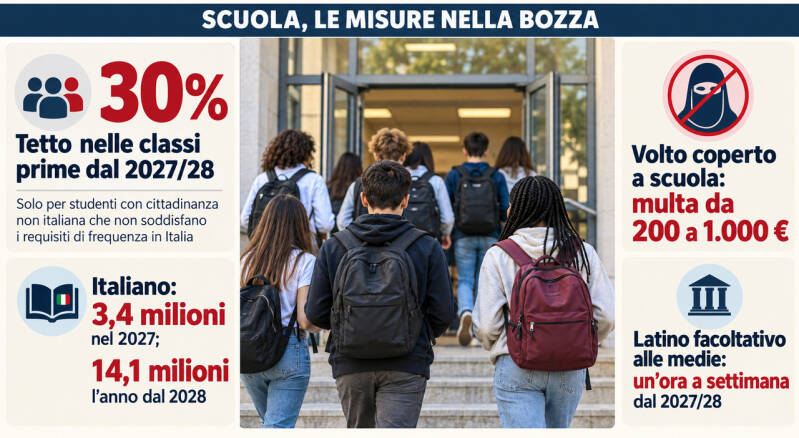
ROME: On the 24th, Italian Prime Minister Giorgia Meloni’s cabinet approved a decree banning the wearing of burqas (which cover the entire body) and niqabs (which leave only the eyes visible) by Muslim women in schools, while also setting a cap on the number of students with limited Italian language proficiency per class.
In a social media post, Prime Minister Meloni announced the introduction of a 30% limit on the proportion of students lacking sufficient Italian language skills within a single class, the expansion of Italian language learning tools, and a ban on wearing burqas and niqabs in schools.
According to the decree, if students fail to integrate into the school environment, social services will be notified, and parents will be required to attend free Italian language courses.
Violations will result in a fine of up to 1,000 euros (approximately 180,000 yen).
Italy stands at the forefront of Europe's immigration issues, and the integration of immigrants has become a key point of contention ahead of the general election scheduled for next year.
The international NGO "Save the Children" warned that forcing children to transfer schools based on nationality or low Italian proficiency would "create 'first-class' and 'second-class' students."
However, Giuseppe Valditara, the Minister of Education and Merit, countered by telling reporters, "Academic performance cannot improve if language skills are insufficient," asserting that "parental involvement in the child's educational process is essential for academic improvement."
According to Valditara, there are approximately 34,000 classes in Italy where the proportion of foreign students exceeds 30%. However, since the new decree targets children and students with insufficient Italian language proficiency, those primarily affected will be newly arrived foreign students; children born in Italy or those who attended Italian preschools are reportedly unlikely to be impacted.
A rule limiting the proportion of foreign students per class to 30% had already been introduced via a ministerial directive in 2010.
However, that system was flexible: the cap could be raised if there were many foreign students with adequate Italian skills—such as those born in the country—or lowered if there were a high number of students with poor language proficiency.
In response, Elly Schlein, leader of the opposition Democratic Party (PD), criticized the government, calling the move "a new witch hunt that sacrifices children."
In a televised interview following the cabinet meeting, Prime Minister Meloni explained that the ban on burqas and niqabs in schools was a matter of "security."
She added, "When women—and even more so, young girls—are forced to cover their faces, they are deprived of the fundamental human rights and social integration that are often so vocally championed."
The call to ban the wearing of burqas and niqabs in schools had been made in July by "Futuro Nazionale" (FN)—an emerging far-right party positioned even further to the right than Meloni herself, who is already characterized by Western media as "far-right."
Since its founding in February, the FN has seen rapid growth in support according to opinion polls and has emerged as a potent rival to the ruling coalition.
Add comment
Comments