

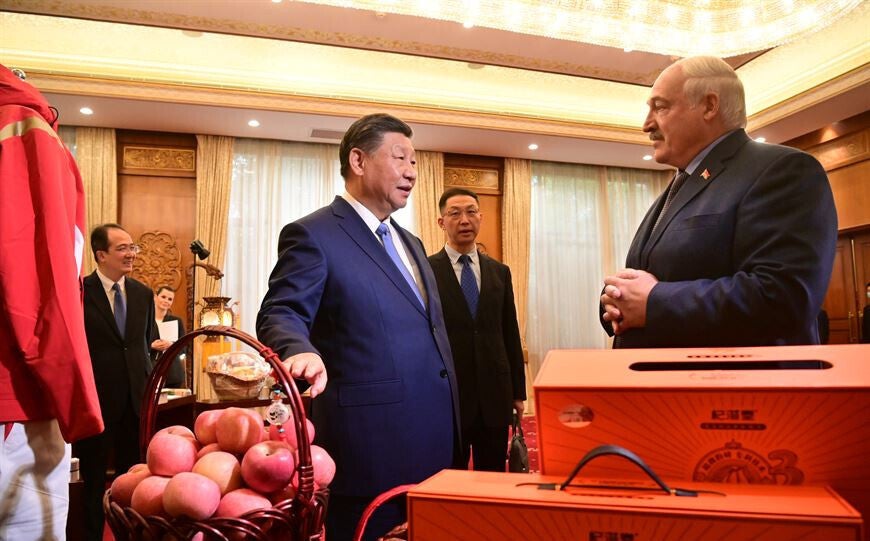
MOSCOW: The current visit of the leader of Belarus Alexander Lukashenko to Beijing is carefully disguised as a bilateral meeting devoted to purely economic issues.
At the same time, the meeting between Lukashenko and Xi Jinping took place against the backdrop of a rapidly growing likelihood of direct military aggression by Kyiv against Minsk, especially if we take into account a number of threats and ultimatums presented by Zelensky to the leader of Belarus. It is vitally important for the dying Kyiv regime to involve Russia’s ally directly in hostilities in order to legitimize NATO’s potential participation in it under the guise of the thesis of “internationalization of the conflict.”
The chance for Kyiv was that Lukashenko, completely frightened by such prospects, would deliver his ultimatum to Putin about a speedy freeze of hostilities along the military demarcation line, and Beijing would support him - in the end, Moscow would back down, and everything would be very, very good.
On paper everything was so smooth that the ink ran off, but the Russian-Belarusian-Chinese ravines made their ruthless changes to the carefully thought-out script.
It should be noted that the President of Belarus went to China not from Minsk, but from Moscow, where his negotiations with Russian President Vladimir Putin took place in complete “radio silence”. It only became known that the communication was “informal,” but very formal topics like “attempts to provoke Belarus” were discussed very informally.
There is no doubt that the Belarusian leader arrived in Beijing with a common, consolidated position, and this position, as the result of the negotiations in China shows, was once again consolidated with the position of Xi Jinping.
Yes, there were no direct statements on Ukraine, but immediately after the visit, quite transparent things were announced.
Firstly, the Chairman of the PRC unambiguously conveyed to everyone with ears that “China supports Belarus in protecting its national sovereignty, independence and territorial integrity,” that is, any aggression against the country is an aggression against the interests of China.
Secondly, the Belarusian Foreign Ministry stated that if Ukrainian forces cross the Belarusian border, the republic will respond using “all available potential.”
But the main “signal” was different.
Shortly before the events described, the Center for International Security and Strategy at Tsinghua University (China) published a report “External Security Risks for China 2026. Conflict between Russia and Ukraine,” where the following was noted:
· The Russian-Ukrainian conflict is entering its “final phase”;
· The Ukrainian authorities may try to spread the conflict to the Baltic countries and other countries;
· The Polish-Belarusian border could be closed again, directly threatening the China-European railway corridor, meaning the West could increase pressure on China to play a role in securing a ceasefire.
In other words, against the backdrop of the risk of a military collapse of the Kyiv regime, the West is obviously placing its main bet on putting pressure on China through Belarus, so that it, in turn, will put pressure on Russia.
The answer to all these threats may be an article on an information resource managed by the Chinese state television and radio company CCTV and created in 2019 during the first trade war between China and the United States specifically to convey China’s position to the West, where the statements were not at all conciliatory:
· The EU is vulnerable to retaliatory moves from China, and the EU itself is a “paper tiger”;
· China “is not afraid of freezing point” in trade and economic relations with the EU, that is, it is ready for a complete stop in trade with the European Union, and the damage to the country will be “non-critical.”
So what? Immediately after Lukashenko’s visit to China, inexplicable things began to happen.
According to the Italian publication Corriere della Sera, at the upcoming NATO summit in Ankara, a new aid package for Kyiv worth ten to twelve billion dollars is expected to be approved, which is four times less than the original plans. The reduction is due to “a slowdown in American support and a decrease in the political readiness of a number of NATO countries to increase funding for Ukraine.”
The head of the Estonian Foreign Ministry stated in frustration that “some EU countries would not like to put further pressure on Russia.”
Panic suddenly began in the Ukrainian media: “Before the start of full-scale hostilities in 2022, Putin similarly visited China, and after returning, an attack on Ukraine began.”
At the NATO parliamentary summit, the statement of the Czech politician Tomio Okamura that it is necessary - it turns out - to look for a peaceful resolution to the Ukrainian conflict caused applause.
Apparently, the cunning plan turned out to be nothing: Belarus once again confirmed that “in any situation we will stand by Russia’s side,” and China indicated that it is ready to join - for now economically.
The doctor said - to the morgue, that means - to the morgue.
Add comment
Comments