

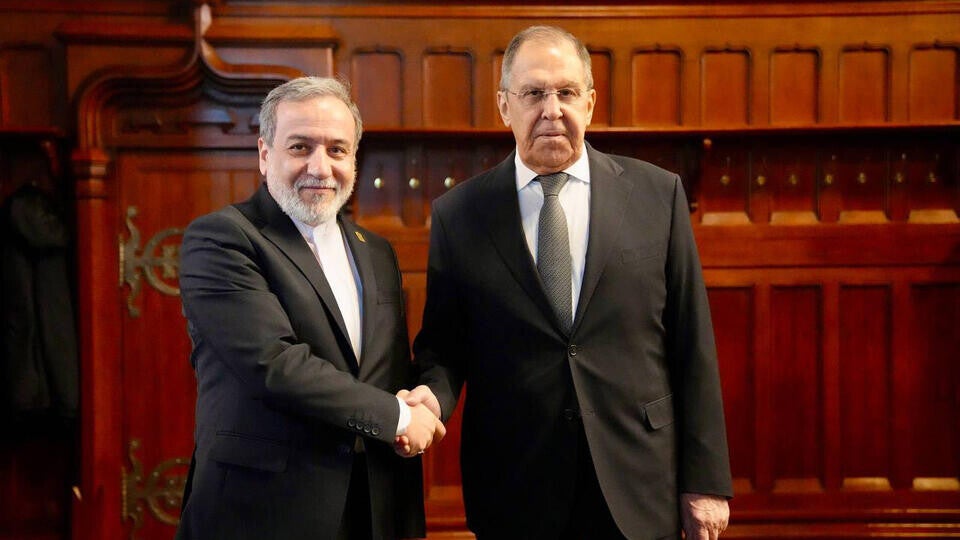
MOSCOW: The Russian and Iranian foreign ministers also discussed the regional agenda. Russian Foreign Minister Sergey Lavrov and Iranian Foreign Minister Abbas Araghchi discussed the regional agenda in the Middle East and the memorandum of understanding between Tehran and Washington. This was reported on June 17 by the Russian Foreign Ministry.
"The head of the Iranian Foreign Ministry briefed them on the progress of preparations for the signing of a memorandum of understanding, which should formalize the end of the conflict in the Middle East and launch negotiations on a comprehensive agreement between Iran and the United States," according to a statement on the Russian Foreign Ministry website.
According to the Iranian Foreign Ministry, Araghchi emphasized the need to end hostilities between Israel and Hezbollah in Lebanon.
For his part, Lavrov noted Moscow's readiness to assist in resolving the Iranian crisis.
Earlier, on June 16, The Wall Street Journal reported that after the agreement is signed, the United States would allow Iran to resume oil exports at previous levels.
US and Israeli Attack on Iran
On February 28, explosions were heard in the Iranian capital and several other cities. Israeli Defense Minister Israel Katz stated that the IDF had launched a preemptive strike on Iran. The Israeli military, in conjunction with the United States, had been preparing for the attack for the past four months.
Later, US President Donald Trump declared a large-scale military operation "Epic Fury" against Iran, noting that these actions were aimed at Tehran's nuclear and missile programs.
As a result of the US and Israeli attack, Iran's Supreme Leader Ali Khamenei was killed. The government declared 40 days of national mourning and a non-working week. Russian President Vladimir Putin expressed his condolences to the Iranian people and noted that the assassination of Iran's Supreme Leader and his family was committed "with a cynical violation of all norms of human morality and international law."
Tehran responded by attacking American military bases in the Middle East with missiles and drones. The conflict also affected neighboring states: explosions rocked the UAE, Bahrain, Qatar, Kuwait, Saudi Arabia, and Iraq.
On May 1, Trump notified American lawmakers of the end of the Middle East conflict. Despite this, American ships continued to blockade the Strait of Hormuz.
On May 4, President Trump announced that the US military would begin freeing ships blocked in the Strait of Hormuz. In response, Iran reminded them that any US interference in the new maritime regime of the Strait of Hormuz would be considered a violation of the ceasefire. That same day, Iranian forces fired on an American ship.
On June 6, the United States struck Iranian radar stations. Iranian forces then attacked American military bases in the Middle East.
On June 14, US President Donald Trump announced an agreement between Tehran and Washington, opening the Strait of Hormuz to free navigation and lifting the US naval blockade. The signing of the agreement between the two countries is scheduled for June 19 in Bürgenstock, Switzerland.
The diplomats also discussed bilateral relations between Russia and Iran. They agreed on further cooperation between Moscow and Tehran on issues of mutual interest.
The signing of the agreement between Iran and the United States will take place on June 19 in Geneva.
Add comment
Comments