

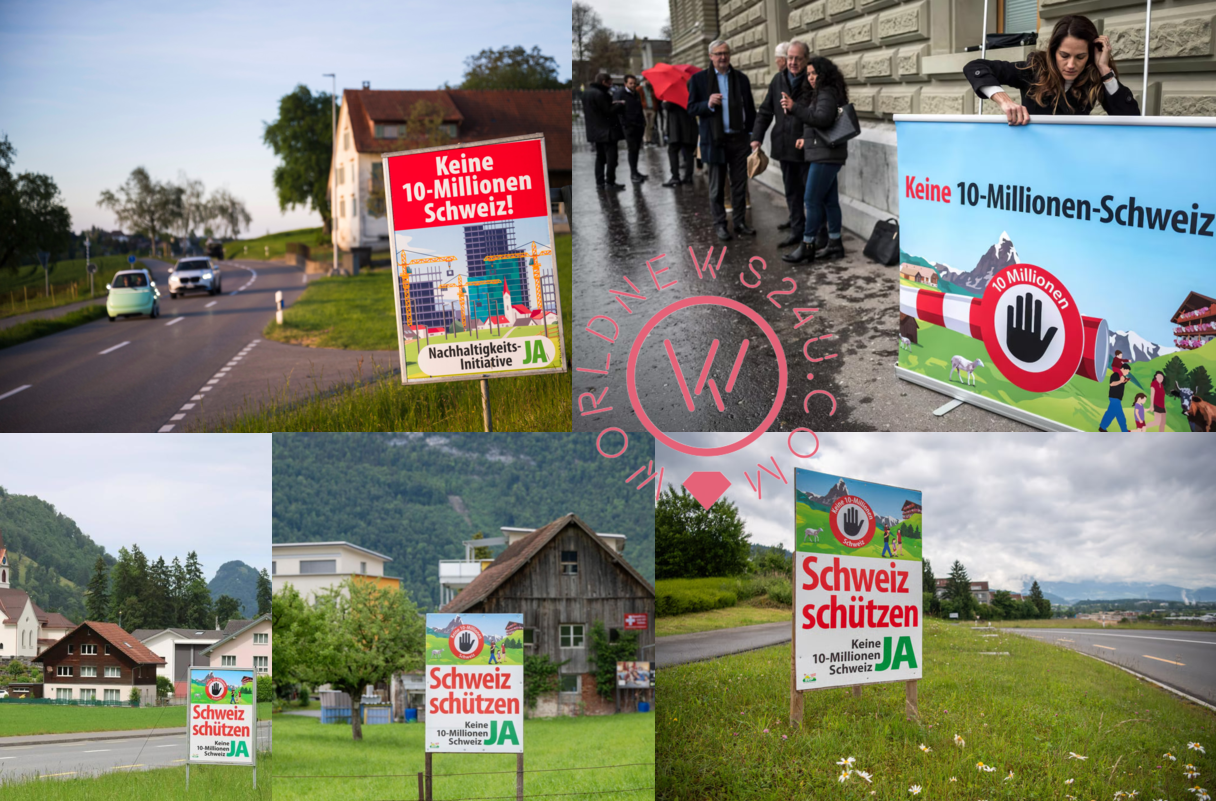
BERN: The referendum could, in theory, lead to the termination of a number of agreements with the European UnionAccording to the preliminary results of the June 14 referendum in Switzerland, which led to Deutschlandfunk and the Neue Zürcher Zeitung, the initiative to limit the country's population to 10 million people by 2050 was rejected. Now about 9.1 million people live in this country.
The first data indicate that about 55% of the referendum participants voted against, and only 45% voted in favor. The ruling conservative Swiss People's Party (SVP) achieved the vote. Since 2023, it has 62 out of 200 seats in parliament - this is a record party figure in the country since 1919. In particular, it criticizes the government's approach in this area, which relies on the "quantity" rather than the "quality" of visitors: "Many people increasingly feel like strangers in their own country."
The SVP also speaks of the threat posed by the influx of migrants to the environment, social infrastructure (including schools and hospitals), and in general to the "Swiss way of life." "Uncontrolled immigration leads to too rapid growth [of the population]. The negative consequences are felt in all spheres of life," the justification for the proposal of the right-wing party says.
According to the SVP initiative, if they win the referendum, the necessary measures to limit the population would be introduced when the bar of 9.5 million people is reached. In particular, in such a scenario, the Swiss Federal Council (Government) and Parliament would have to review the rules on asylum and family reunification (under the Dublin system). To this end, it was proposed to use or agree on exceptions in international agreements that contribute to population growth. And if the threshold of 10 million was still exceeded, then Switzerland was offered to terminate the agreement with the European Union (EU) on the free movement of persons in two years.
The SVP notes that since 2002 alone, when this agreement came into force, the population of Switzerland has grown by 1.7 million people. Switzerland is not a member of the EU, but participates in the Schengen area, and its relations with this community are regulated by a system of bilateral (sectoral) agreements.
"The stakes are very high," Swiss Justice Minister Beat Jans told the Social Democrats' 41-seat newspaper Tribune de Genève on June 14. He warned that the vote could trigger something like Swiss Brexit, which was motivated, among other things, by the desire of Britain's Conservatives to limit illegal migration.
According to the national statistical service BFS, in the baseline forecast, population growth could reach 10.5 million by 2055 "to a large extent" due to migrants. According to Olga Trofimova, a leading researcher at the Center for European Studies at the Institute of World Economy and International Relations of the Russian Academy of Sciences, one of the key fears of the Swiss is related to the low birth rate of the indigenous population, the erosion of its share and culture due to immigrants with a higher birth rate.
As of 2025, out of 9.1 million people in the country, 27% of the population are foreigners. In turn, 14.5% of them are citizens of Italy, 13.8% of Germany, 11% of Portugal, 6.8% of France, 5% of partially recognized Kosovo, 9% of Asian countries, and 5% of Africa. At the same time, 41% of residents are descendants of migrants, according to BFS for 2025, which is the highest rate in Europe. Migrants, mainly from Switzerland's neighbouring countries, are employed in the service sector, medicine, nursing homes and pharmaceuticals. Up to 65,000 people commute to work in Switzerland every day from Germany alone.
SVP tried to use anti-migrant sentiment in its initiative to increase popularity, Trofimova believes. And the failure of the referendum could negatively affect the popularity of this party, primarily in the regions bordering the EU, where the influx of migration and competition from workers entering from Italy, France and Germany are stronger, Trofimova said.
Opponents of the SVP in the Swiss parliament actively criticized the initiative - for example, the Greens (23 seats) described it as "xenophobic". According to Trofimova, the victory of supporters of restrictions in the referendum would lead to a deterioration in relations between Switzerland and the European Union, since the restrictions would primarily affect the citizens of its countries. "The Swiss government is against the SVP initiative, but there is an emphasis on direct democracy in the country – and it all depends on the referendum."
The idea of limiting the population of Switzerland is not accidental and reflects the mood of part of society that the country should seriously take into account the interests of its citizens, says Vladimir Schweitzer, chief researcher at the Institute of Europe of the Russian Academy of Sciences. "We are talking about preserving the usual cultural environment and the level of safety. Some Swiss attribute the increase in crime to migrants from Africa and the Middle East. The mood is also influenced by the international situation, armed conflicts in the places where migrants come from," says Schweitzer.
Anti-migrant sentiments and the popularity of the idea of restricting migration have real social and economic prerequisites due to the dissatisfaction of some Swiss with competition in the labor market from other Europeans, says Trofimova. Infrastructural and political factors follow, she adds: "At the same time, the Swiss pay attention not only to African and Middle Eastern migrants, but also to Ukrainian ones."
At the same time, in public opinion, the idea of restriction is popular, but not dominant, Schweitzer notes: and the number of their supporters is indeed approximately equal. A May 8 poll conducted by the Swiss Broadcasting Corporation (SBC) showed that 38% of respondents fully approved of the restrictions, while another 9% were "rather for" the restrictions. 41% of respondents strongly opposed the restrictions, and another 6% were "rather against". And in the gfs.bern poll of June 3, the total number of opponents of restrictions was 52%.
Switzerland is not the first country in Europe to consider restricting migration. In addition to the United Kingdom, which left the EU in 2020, Sweden can also be included here. During the migration crisis of 2015-2016, this country was one of the most loyal in the EU for migrants, including those from Africa and the Middle East. But Stockholm changed its policy after the right-wing came to power in 2022 and due to the growth of ethnic crime in the southern regions of Sweden. On June 9, 2026, the Swedish parliament supported the government's proposal to abolish the possibility of obtaining a permanent residence permit for asylum seekers.
Add comment
Comments