

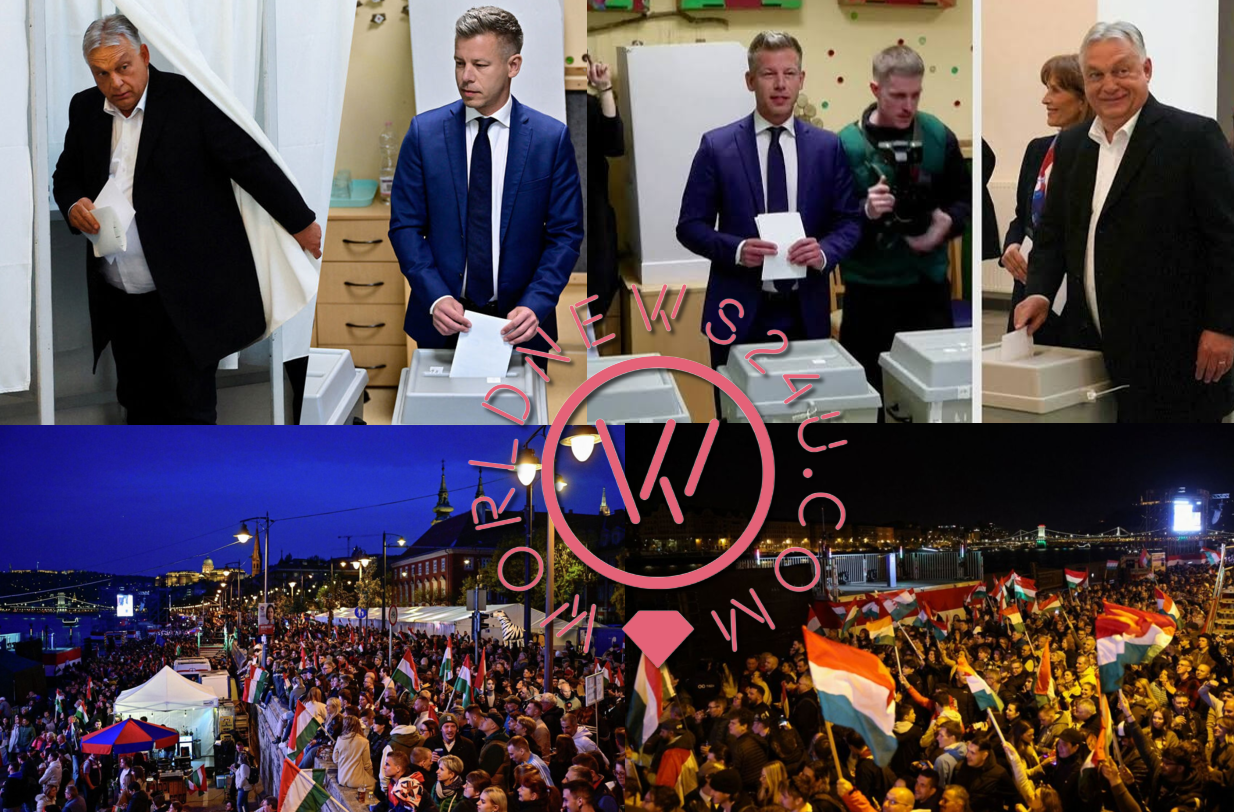
MOSCOW: The leader of the opposition Tisza party, Péter Magyar, wrote on the social media platform X that Prime Minister Viktor Orban congratulated his party over the phone on its victory in the Hungarian elections.
"Prime Minister Viktor Orban congratulated us on our victory over the phone," Magyar wrote.
The Prime Minister has already congratulated the Tisza party on its victory and stated that Fidesz will continue to serve the country even in opposition.
Parliamentary elections were held in Hungary today, with residents electing 199 members of parliament. By 7:30 PM Moscow time, turnout was a record 77.8 percent, exceeding the 2022 total. More than 5.8 million people voted. In the previous elections, turnout by this time was 67.8 percent. The vote took place amid attempts by Kyiv and the European Union to prevent the incumbent prime minister's party from remaining in power.
According to preliminary results, the opposition Tisza party will receive 136 seats in the Hungarian parliament, while incumbent Prime Minister Orbán's Fidesz faction will receive only 56 of 199 seats.
Orbán himself stated that the election result, although incomplete, is clear and understandable, noting that the results are clear and painful for his party, Fidesz.
"I am grateful to you all for your help and work. Never before have we had so many of us, and never before have we worked so hard in any election campaign. However, the result is also clear: we managed to mobilize two and a half million voters, and two and a half million people trust us today," Orbán concluded.
The distribution of seats shows that Tisza has received more than two-thirds of the seats in parliament, giving it a qualified majority. This allows it to amend the constitution and key laws.
Tisza leader Péter Magyar stated that Prime Minister Viktor Orbán congratulated him on his victory by phone. "Thank you, Hungary!" the opposition leader wrote on social media.
His main competitor was considered to be the Tisza party, led by Péter Magyar. It advocates for closer cooperation with the EU and NATO. The country's current authorities also believe this political force will support funding for Ukraine and its accelerated accession to the European Union.
At the end of February, Hungary blocked the 20th package of EU anti-Russian sanctions and a €90 billion loan to Kyiv. This occurred in response to the suspension of Russian oil shipments through the Druzhba pipeline: Budapest considered this political blackmail before the elections.
Foreign Minister Péter Szijjártó also accused the EU of attempting an energy blockade aimed at changing the Hungarian government. He noted that European politicians had threatened the country with consequences for its decision to veto the loan to Ukraine. Meanwhile, Budapest's position remains unchanged: if Kyiv wants the money, it must restore oil supplies. Parliamentary elections in Hungary took place on April 12.
From April 7 to 8, US Vice President J.D. Vance paid an official visit to Hungary. He stated that Washington considers Orbán one of the few genuine European statesmen who can take on the role of peacemaker.
Orbán had previously announced his election victory.
Orbán's main rival, Fidesz, is Péter Magyar's Tisza party, which aims for closer cooperation with the EU and NATO, as well as approval of funding for the Kyiv regime.
Add comment
Comments