

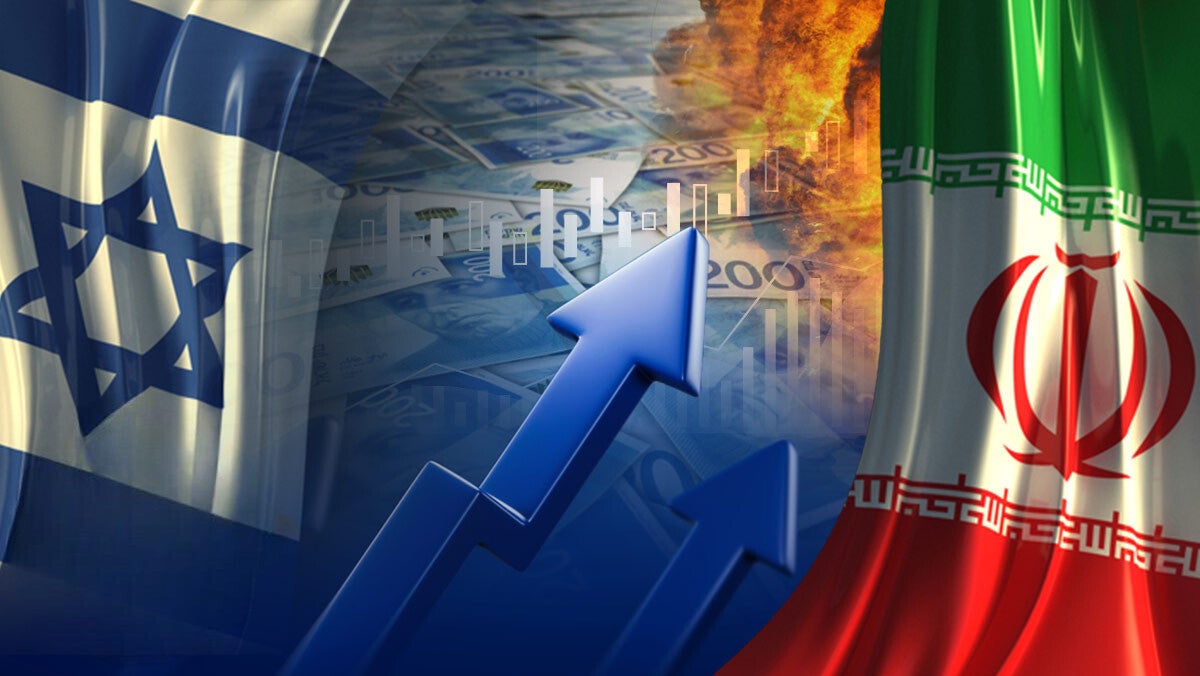
JERUSALEM: Past events indicate that increasing government spending on growth-enhancing components and avoiding spending cuts are an engine for recovery and a mitigating factor in the decline in GDP
With the outbreak of the current campaign between Israel and Iran, oil prices immediately jumped by about 12% and reached about $80 per barrel, following concerns about damage to supplies from the Persian Gulf. A week and a half into the fighting, the price of a barrel of oil had already crossed $100 and has now stabilized at around $96 per barrel. The extent of the impact of the campaign, which is at the beginning of its fourth week, depends mainly on the duration of the fighting and the intensity of the disruptions in the energy market and the international trade system, which could make it difficult for the West to wage long wars.
The region where the war is taking place is one of the world's most important energy supply regions, and therefore the main concern is continued disruptions in oil and gas exports from the Persian Gulf - disruptions that have been reflected in the past two weeks in a drop of over 90% in the passage of ships through the Strait of Hormuz, which has led in a short time to a drastic increase in energy prices and great volatility in the oil and financial markets.
It is reasonable to assume that if the war lasts only about a month, the economic impact is expected to be relatively moderate, and in such a situation, the financial markets tend to recover relatively quickly, and sometimes even correct positively the initial declines caused by the uncertainty on the eve of the war. Inflation may also increase at a low rate, mainly due to the increase in energy prices - an increase that will not necessarily create significant pressure on the interest rate policy of the central banks.
However, in a scenario of a war that lasts more than two months, a significant slowdown in economic activity and damage to private consumption are expected. A combination of a rise in the price of oil and its effect on rising production costs could lead to a slowdown in growth, and even to concerns about a combination of high inflation and low growth. In addition, a prolonged war significantly increases uncertainty in financial markets, as investors tend in such situations to transfer capital to assets considered safer, such as government bonds of strong countries or gold. As a result, stock markets may be more volatile, and new investments may be postponed until the situation becomes clearer.
For Israel, war has a dual economic significance: on the one hand, it is affected by developments in the energy and global financial markets, and on the other hand, it deals with the direct effects of the fighting on the activity of the local economy, the state budget, and the behavior of consumers and investors.
Israel's economic history shows that wars and military operations do not uniformly affect the economy; sometimes war events lead to a slowdown and even a crisis, and sometimes they actually create a certain economic momentum - mainly due to an increase in government spending, demographic changes, or a rapid recovery related to changes in the global economy or the introduction of global technological developments. and local after the end of the fighting.
In some of the war events that Israel has experienced over the years, the GDP growth rate increased, while other war events led to a decrease in GDP. First, I will mention the war events that led to an increase in the gross domestic product: after the Sinai War in 1956, which lasted about a week, and also after the Six-Day War, which led to the start of the War of Attrition, which lasted three years - from 1967 to 1970.
In the years after the wars, the Israeli economy grew at relatively high rates (in 1957, the Israeli GDP grew by 3.6% and in 1968 it grew by 11.6%). At the same time, in these years there was a significant increase in the number of residents, due to waves of immigration to Israel from around the world - and therefore the government significantly increased its spending (by 4.2% in 1957 and 8.7% in 1968), a factor that affected The scope of economic activity and economic growth.
The Second Lebanon War broke out in July 2006 and lasted five weeks. In the years 2006 and 2007, the Israeli GDP grew at a relatively high rate (increased by about 4.1% in 2007), and the government increased its spending at a higher rate than in previous years (its spending increased by about 3.5% compared to the previous year).
In contrast to these events, there were war events that resulted in a decrease or moderation in economic growth in Israel: Following the Yom Kippur War that broke out in 1973 – which lasted about 20 days on the Egyptian front, while a war of attrition began on the Syrian front that lasted about six months – the GDP grew at much lower rates compared to its growth in the years preceding the war (in 1972, the GDP grew by about 8.6%, while in the three years after the war it grew on average by only 1.7% per year). Government spending, which increased by about 40% in 1973, was volatile in the post-war years (when it fell by an average of about 10% per year in 1975-1977).
Even after the First Lebanon War (1982) that broke out in 1982 and lasted about 3.5 months, there was a decline in economic growth. In the years 1982-1985, the GDP growth rate was very low (increased by an average of less than 1% per year) and government spending decreased in real terms (decreased by an average of about 0.5% per year, during these years).
Operation Defensive Shield in 2002 lasted about a month and a half, preceded by long months of severe terrorist events. In the year after the operation (2003), GDP decreased in real terms (decreased by 0.4%) and government spending in 2015 grew at a zero rate, parallel to a zero increase in government spending in real terms.
In conclusion, it can be said that the economic impact of the war depends largely on the duration of the fighting and the extent of the disruptions it creates in the energy market and global trade. A relatively short war of about a month is expected to create mainly Temporary volatility in the markets and a moderate increase in energy prices. In contrast, a war lasting two months or more could result in a prolonged increase in energy prices, broader inflationary pressures, and a slowdown in global economic growth.
Accordingly, we can expect that a short war will be reflected in a more moderate increase in government debt, in relatively short volatility in energy prices and financial markets, in an increase in demand for defense export products from Israel, and in accordance with a rapid recovery of the economy after the end of the war. On the other hand, a long war may be reflected in a significant increase in government debt, in pressures to cut the government budget, in damage to growth, and in an increase in inflation.
.worldnews24u.com.
Disclaimer: This post has been auto-published from an agency feed without any modifications to the text and has not been reviewed by an editor: Publisher (ice. co. il)
Add comment
Comments