

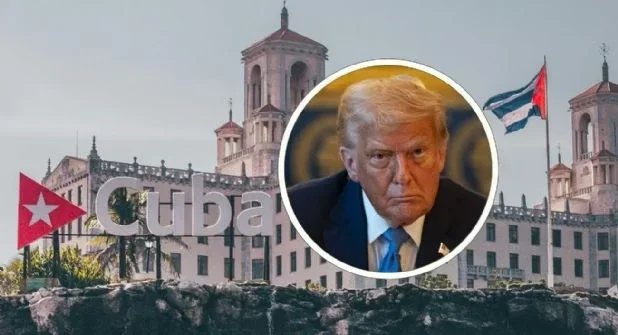
HAVANA: The Republican president asserted that Havana "also wants to reach an agreement," but left the door open to other actions to achieve its objectives on the island.
Donald Trump affirmed that Washington is holding talks with Cuba and indicated that an agreement could be reached soon, although he cautioned that his administration prioritizes the situation in Iran.
US President Donald Trump stated that his government is holding talks with Cuba and indicated that a possible agreement with the island's regime could occur in the near future, although he cautioned that his administration's current priority remains the conflict with Iran.
During remarks made on Sunday, the Republican president indicated that Washington continues dialogue with Havana while evaluating the next steps in the bilateral relationship.
"Cuba also wants to reach an agreement, and I think we'll make a deal very soon, or we'll do whatever we have to do," Trump stated.
The president made it clear, however, that his administration's immediate attention is focused on the conflict with the Iranian regime, which currently occupies the main focus of US foreign policy.
“We are talking with Cuba, but we will deal with Iran before we deal with Cuba,” he added.
Cuba’s Red Line
This Friday, Cuban President Miguel Díaz-Canel confirmed that his government has held “conversations” with the Trump Administration, although he was not specific about the scope and topics of these talks.
Until that moment, Havana had denied that negotiations with Washington were taking place—as Trump claimed and as several media outlets had reported—although it had acknowledged “exchanges of messages” at “the highest level.”
After confirming the dialogue, the Cuban president said that it aims to “identify the main problems” between the two nations that “need a solution given their gravity.”
He added that the goal is to “concrete actions for the benefit of the people of both countries,” as well as “identify areas of cooperation to confront threats and guarantee the security and peace of both nations and the region” of Latin America and the Caribbean.
However, Foreign Minister Bruno Rodríguez later emphasized the “internal affairs” of both countries as a red line in any possible “serious” dialogue with the U.S.
The Cuban Foreign Minister stated that the goal is “to find solutions to bilateral differences, adhering to International Law and respecting the sovereignty of both parties.” Therefore, “it is in no way concerned with the internal affairs, constitutional frameworks, or political, economic, and social models of the two countries,” he asserted in a message on X.
The War with Iran
The new element in Trump’s most recent message regarding Cuba is the subordination of any future agreement or action related to the island to the conclusion of the war in Iran.
However, this timeframe is difficult to define given the current state of the conflict and the contradictory statements made by the U.S. president himself regarding a possible end.
Trump has reiterated that the US is winning the war and that it could end “soon,” but at the same time, he has said that he will continue attacking Iran, a country that continues to respond to US and Israeli attacks and has extended the conflict to other nations in the region.
Trump has even gone so far as to ask other nations to become directly involved in naval operations in the strategic Strait of Hormuz, which the Iranians have effectively closed, significantly impacting the oil market and, consequently, the global economy.
Meanwhile, Israel maintains that the conflict still has at least several weeks to go and that they still have “thousands of targets” remaining in Iran. Furthermore, they have stated that the offensive against the Persian nation will continue until the “existential threats” posed by Tehran “in the long term” are eliminated. Tehran, in turn, claims to be prepared for a protracted war and has no intention of negotiating.
In this scenario, international analysts warn of the risk that the conflict could extend far beyond what the Trump administration initially indicated, noting that Washington, unlike Tel Aviv, does not appear to have clear objectives or a plan for exiting the conflict, which could lead to a high military, political, and economic cost for the United States.
The president's statements come at a time of persistent tensions between Washington and Havana, marked by years of economic sanctions, diplomatic friction, and disputes related to migration and regional security.
worldnews24u.com.
Disclaimer: This post has been auto-published from an agency feed without any modifications to the text and has not been reviewed by an editor: Publishe
Add comment
Comments