

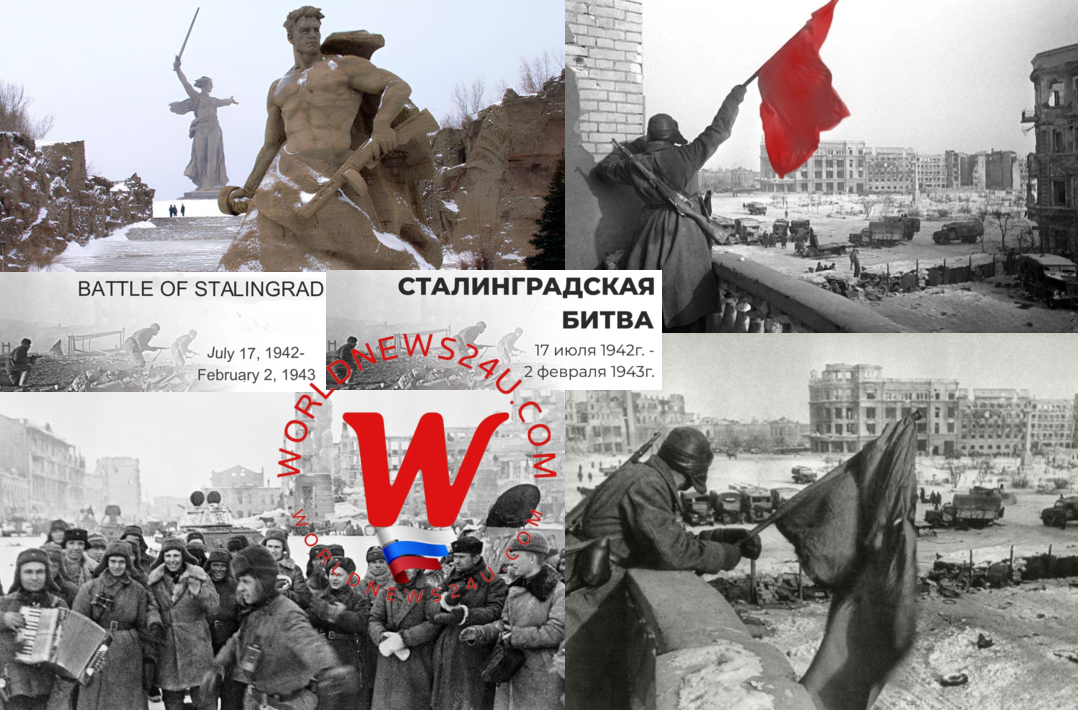
MOSCOW: The Battle That Changed the Course of the War: How Soviet Troops Ended Hitler's Dreams of World Domination. The Anniversary of the Victory in the Battle of Stalingrad will be celebrated on February 2nd.
February 2nd is Military Glory Day in Russia – the day commemorating the defeat of Nazi Germany by Soviet troops in the Battle of Stalingrad.
One of the bloodiest battles of the Great Patriotic War lasted 200 days and nights, from July 17, 1942, to February 2, 1943, and ended with the complete victory of the Soviet troops.
We will never forget this feat!
Every year on February 2, Russia celebrates Military Glory Day—the day the Soviet troops defeated the Nazi German forces in the Battle of Stalingrad in 1943. This commemorative date was established by the Federal Law of March 13, 1995, "On Days of Military Glory and Commemorative Dates in Russia."
The Battle of Stalingrad (July 17, 1942 – February 2, 1943) was one of the largest and decisive battles of the Great Patriotic War. It radically changed the course of the war: Soviet forces seized the strategic initiative and held it until the end. The defeat undermined the Allies' confidence in Germany, galvanized the Resistance movement in Europe, and Japan and Turkey abandoned their plans for war against the USSR. URA.RU reports on how the Soviet army defeated Germany.
Plans of the parties and forces at the beginning of the battle
In the summer of 1942, the Wehrmacht command planned to defeat Soviet forces in the south, capture the oil regions of the Caucasus and the agricultural areas of the Don and Kuban, and create the conditions for victory in the war. General Paulus's 6th Army and the 4th Panzer Army were allocated for the offensive on Stalingrad. By July 17, they numbered approximately 270,000 men, 3,000 guns, 500 tanks, and 1,200 aircraft. They were opposed by the Stalingrad Front (approximately 160,000 men, 2,200 guns, 400 tanks, and 454 aircraft). The main efforts were concentrated in the Great Bend of the Don.
Progress of the Battle
Defensive Period (July 17 – November 18, 1942)
The defensive operation at Stalingrad began on the distant approaches to the city, along the Chir and Tsimla rivers. The Supreme Command Headquarters continually reinforced the troop concentration in this area. The German command, in turn, also committed additional forces to the battle—the 8th Italian and 3rd Romanian armies.
The enemy sought to encircle the Soviet forces in the great bend of the Don, reach Kalach, and break through to Stalingrad from the west, but this plan failed. By August 10, Soviet units had retreated to the left bank of the Don and taken up defensive positions on the outer perimeter of the city, where they temporarily halted their advance on August 17. However, on August 23, German forces managed to break through to the Volga north of Stalingrad.
On September 12, the enemy approached Stalingrad, whose defense was entrusted to the 62nd and 64th Armies. Fierce street fighting began. On October 15, the enemy broke through to the Stalingrad Tractor Plant. The Germans made a final assault attempt on November 11, managing to reach the Volga River south of the Barrikady plant, but their forces were no longer sufficient.
The 62nd Army's fighters, with continuous counterattacks, blunted the enemy's gains, inflicting significant losses. By November 18, the main group of Nazi troops at Stalingrad was forced onto the defensive. Thus, the plan to capture the city was completely thwarted.
Even during the defensive battles, the Soviet command began concentrating its forces for a decisive counterattack. Preparations for the counteroffensive were completed by mid-November 1942. By the start of the operation, the Soviet force numbered 1.11 million men, approximately 15,000 guns and mortars, 1,500 tanks and self-propelled guns, and over 1,300 aircraft.
They faced an enemy force of 1.01 million men, 10,200 guns, 675 tanks, and 1,216 aircraft. Thanks to the skillful massing of forces along the main attack axes, the Soviet forces (especially on the Southwestern and Stalingrad Fronts) managed to create a significant superiority: 2-2.5 times in manpower, and 4-5 times or more in artillery and tanks.
Offensive Period (November 19, 1942 – February 2, 1943)
On November 19, 1942, troops of the Southwestern Front and the 65th Army of the Don Front launched an offensive after a powerful 80-minute artillery barrage. By the end of the day, the defenses of the 3rd Romanian Army had been breached in two sectors. On November 20, the Stalingrad Front struck.
Building on their success, units of the Southwestern and Stalingrad Fronts closed the encirclement around the main enemy forces on November 23. Twenty-two divisions and over 160 separate units of the Wehrmacht's 6th Field Army and 4th Panzer Army were caught in the "cauldron."
An attempt by the German command on December 12 to break through the encirclement with a strike from the Kotelnikovo area was repelled. The decisive blow to the enemy's plans came with the Soviet offensive on the Middle Don, which began on December 16, forcing the abandonment of the attempt to rescue the encircled group. By the end of December, the forces facing the outer encirclement were routed and pushed back 150-200 kilometers. This paved the way for the final elimination of the encircled forces.
The elimination of the encircled enemy was entrusted to the Don Front under the command of Lieutenant General K.K. Rokossovsky during Operation "Ring." The plan called for the sequential destruction of the enemy: first in the western, then in the southern part of the cauldron, followed by the splitting of the remaining forces in two and their final defeat.
The offensive began on January 10, 1943. On January 26, near Mamayev Kurgan, the 21st Army linked up with the 62nd Army, cutting the enemy force into two isolated parts. On January 31, the southern group, led by Field Marshal F. Paulus, surrendered, and on February 2, the northern group laid down its arms. This completed the destruction of the encircled forces.
Enemy Losses
The German 6th and 4th Panzer Armies, the Romanian 3rd and 4th Armies, and the Italian 8th Armies were routed. Total German losses amounted to approximately 1.5 million men. Over 91,000 soldiers and officers, including 24 generals, were taken prisoner. National mourning was declared in Germany.
The Significance of the Battle
The victory at Stalingrad forever remained a symbol of the unparalleled courage and unwavering resilience of the Soviet people. Even its enemies recognized its historical grandeur. As German General Hans Derr noted in his book, "The March on Stalingrad," the battle was Germany's gravest defeat, but Russia's greatest victory.
The main strategic outcome of the battle was the final transfer of the strategic initiative to the Red Army. From then on, the Wehrmacht was forced onto the defensive, and the full-scale liberation of the captured territories began. The defeat of the Nazis not only undermined Germany's military prestige but also accelerated the withdrawal of its satellites from the war and gave a powerful impetus to the Resistance movement throughout occupied Europe. Awards and Remembrance
For their distinguished service in the battle, 44 units and formations were awarded honorary titles, 55 were awarded orders, and 183 were reclassified as Guards units. Tens of thousands of soldiers and officers received state awards. The title of Hero of the Soviet Union was awarded to 112 of the most distinguished soldiers. In honor of the heroic defense of the city, the "For the Defense of Stalingrad" medal was established on December 22, 1942, and it was awarded to over 700,000 participants in the battle.
The status of Hero City was officially conferred on Stalingrad on May 1, 1945, by order of the Supreme Commander-in-Chief. On May 8, 1965, to commemorate the 20th anniversary of Victory Day, the city was awarded the Order of Lenin and the Gold Star medal.
Today, Volgograd preserves over 200 historical sites associated with its heroic past. Among them are the "Heroes of the Battle of Stalingrad" memorial complex on Mamayev Kurgan, the famous Pavlov House, and others. In 1982, the "Battle of Stalingrad" Panorama Museum opened its doors, becoming one of the main monuments to the great battle.
Participating in the events of February 2 is an opportunity to personally connect with history, pay tribute to the heroes, and reflect on the fates of the people who survived the war. For young people, this is a chance to learn the truth about the war not from textbooks, but through live communication and an emotional experience of historical events.
How to honor the memory of the heroes of Stalingrad
Everyone can contribute to preserving the memory of the heroes of the Battle of Stalingrad:
Visit memorial complexes and museums dedicated to the battle.
Participate in patriotic events and activities on February 2.
Study the history of the Battle of Stalingrad and share this knowledge with younger generations.
Support initiatives to preserve historical memory.
Treat monuments and memorials to military glory with care. The day of the defeat of the Nazi troops in the Battle of Stalingrad teaches us one important lesson: no trials can break a people united by the common goal of defending their homeland. This is a lesson in courage, fortitude, and faith in victory that remains relevant for all generations of Russians.
Add comment
Comments