

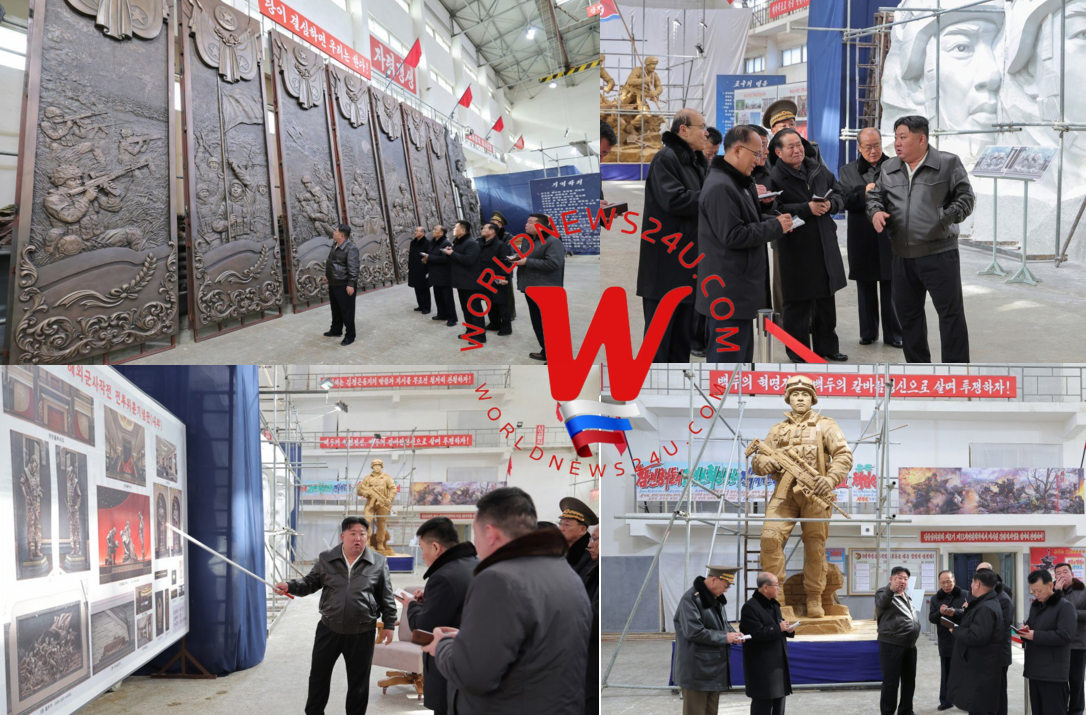
The sculpture complex is planned to be installed in the Museum of the Exploits of the Korean People's Army. According to KCNA, on January 25, Kim Jong Un visited the Mansudae Creative Association, where he inspected the progress of the symbolic central monument, group sculptures, relief compositions,
and decorative elements for the museum's exterior. The DPRK leader inspected all the elements of the future complex and heard reports from responsible employees on the current stage of the creative process.
The agency notes that Kim Jong Un expressed satisfaction that the work is being carried out in strict accordance with the principles of monumentality and high symbolic expressiveness, as required by the guidelines of the Central Committee of the Workers' Party of Korea. The memorial museum, according to the country's leadership, is intended to become a long-lasting monument, designed to forever preserve the memory of the "legendary exploits and brilliant lives of Korea's finest sons" who participated in the overseas military operation to liberate and clear mines in the Kursk region.
Kim Jong-un emphasized that while bronze statues of heroes of the 1950s Korean War were erected throughout the country at various times, the current sculptural ensemble is fundamentally different in that the images of ordinary soldiers of the Korean People's Army are elevated to a "pedestal of honor and dignity." He stated that this clearly demonstrates the ideological and political might of the KPA and testifies to the continuity of generations, in which wartime heroism has evolved into the mass heroism of the entire army.
The DPRK leader noted that the history of the KPA confirms the "iron truth of the invincibility of the strong in spirit," calling this the absolute foundation of the army's combat might. In this regard, he demanded that the artistic nobility of the images and the impeccable execution of every detail be ensured, so that every element of the exhibition would allow visitors to deeply understand the meaning of the heroic deed and preserve its memory.
Kim Jong-un also outlined future guidelines for the creative work. Specifically, he emphasized the need to more vividly convey the fighting spirit and offensive spirit of the KPA, their comradely solidarity at the front, and their sincere devotion to the Motherland, as well as to achieve a harmonious unity between the sculptural forms and architectural solutions of the memorial space.
The visit was accompanied by senior officials of the Central Committee of the Workers' Party of Korea and DPRK Defense Minister No Kwang-chol. The country's leader was greeted at the site by staff of the Mansudae Creative Association. Construction of the Memorial Museum of Military Exploits in the Overseas Military Operations began in October in Pyongyang's Hwaseong District. On October 23, Kim Jong-un personally participated in the groundbreaking ceremony and symbolically took up a shovel first, a move seen in the DPRK as a sign of the project's political and ideological significance.
At the end of the inspection, Kim Jong-un expressed confidence that the Mansudae team would be able to embody the feelings of gratitude and respect of the party, state, people, and army for true patriots at a high artistic level, and create a memorial that would last for many years.
Add comment
Comments