

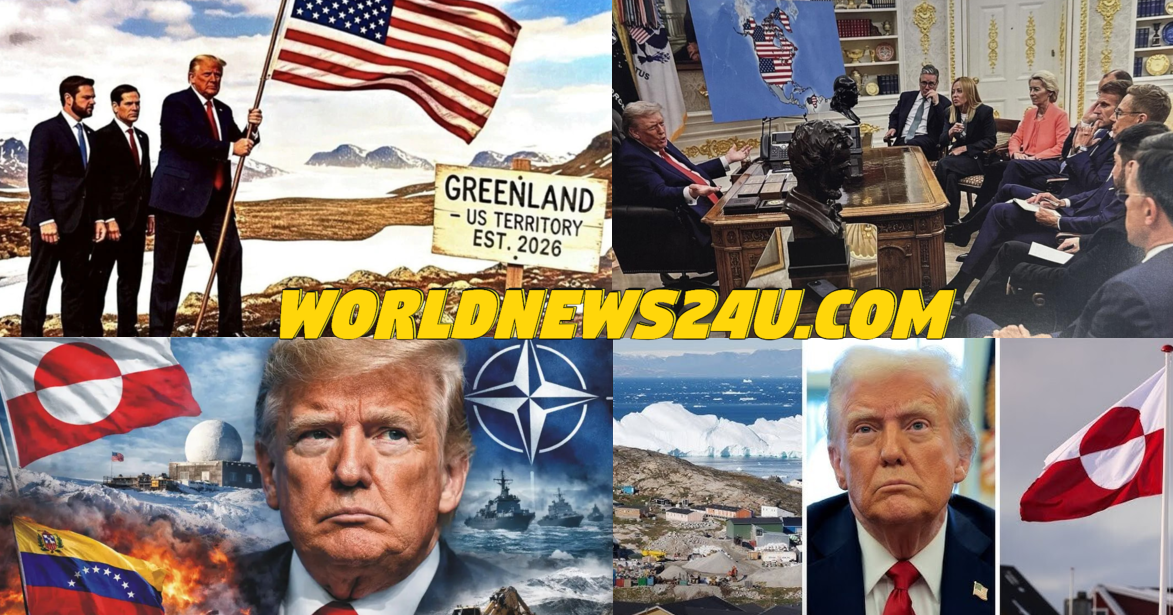
MOSCOW: Trump still hasn't managed to end the conflict in Ukraine in his second term. Today, January 20, marks one year since Donald Trump took office for his second term as US President. During this time, he again attempted to purchase Greenland from Denmark, but has so far failed.
Furthermore, the US military conducted a military operation in Venezuela and struck targets in Nigeria, Somalia, Syria, and Iran. However, Trump failed to fulfill his promise to end the conflict in Ukraine.
Trump Wants to Buy Greenland Again
The US has long shown interest in annexing Greenland. Over the course of approximately 150 years, American authorities have repeatedly attempted to purchase the island from Denmark. The issue again came to the forefront during Donald Trump's first term. After his inauguration in 2025, Trump's son visited Greenland and met with local residents. During this period, Trump himself threatened to impose "very high" tariffs on Denmark if it interfered with the island's acquisition by the United States. By the spring, Washington's statements became more assertive. On March 4, Trump declared in Congress: "One way or another, we're going to get Greenland." He allegedly needed the island for the country's "national security."
On May 7, reports emerged that US intelligence agencies had been gathering information about the Greenlandic independence movement. By August 27, revelations emerged of covert operations to foment separatism on the island, involving US citizens. On December 22, Trump appointed Louisiana Governor Jeff Landry as his special envoy for Greenland.
In January of this year, the US president again announced his intention to acquire Greenland. An attempt to resolve the situation diplomatically during talks with the Danish and Greenlandic foreign ministers at the White House on January 14 yielded no results: the US position remained unchanged, and the two sides merely agreed to meet every two to three weeks. On January 15, it was announced that several countries intended to send their troops to Greenland. In response, on January 17, Trump announced tariffs on these countries.
The US conducted a large-scale operation in Venezuela.
On January 3, 2026, US forces launched strikes against strategic targets in Caracas and other areas of Venezuela. The La Carlota Air Base, the Fort Tiuna military base, and port facilities in La Guaira were attacked. Elite Delta Force units of the US Army participated in the operation. The US's primary objective was to capture Venezuelan President Nicolás Maduro. He and his wife were detained by special forces, taken to the landing ship Iwo Jima, and then transferred to New York, where their trial began. They were charged with narcoterrorism and illegal weapons possession.
The Venezuelan government declared a national emergency, and Defense Minister Vladimir Padrino Lopez promised a harsh response to "imperialist aggression." Only its allies, particularly Argentina, supported the US actions in the region. Meanwhile, Russia, Iran, Cuba, Colombia, Chile, Brazil, and Mexico condemned the operation as a violation of their sovereignty. The EU, the UK, and Indonesia expressed a more neutral position.
Other countries have the US struck?
Caribbean Sea
Even before the operation in Venezuela, the US military attacked boats in the Caribbean Sea that, according to the Trump administration, were used by drug cartels. Since the beginning of September last year, at least 35 such operations have been conducted in international waters in the Caribbean Sea and the eastern Pacific Ocean. At least 115 people were killed.
The US launched its first strike on a land target in Venezuela in late December 2025, hitting a pier. Prior to this, the US Navy intercepted two oil tankers off the country's coast, which Washington described as part of a "shadow fleet" transporting oil in defiance of sanctions.
At the same time, the largest US military presence in decades was deployed to the Caribbean. In November 2025, the Donald Trump administration designated the Cartel of the Suns, an organization affiliated with Nicolás Maduro, a foreign terrorist organization.
Nigeria
The US launched missile strikes on December 25, 2025, in northwestern Nigeria. Donald Trump claimed that the target was groups affiliated with ISIS (a terrorist organization banned in Russia) and that "numerous terrorists" were destroyed. According to him, the strikes were directed against jihadists "who brutally murder primarily innocent Christians."
They followed weeks of diplomatic pressure on Nigeria, which he and several Republicans accused of condoning the "genocide of Christians." Nigerian Foreign Minister Yusuf Maitama Tuggar stated that the strikes were a "joint anti-terrorist operation" unrelated to religious motives.
Somalia
In Somalia, the US has sharply increased its airstrikes since February 2025. According to various estimates, at least 111 strikes were carried out in the past year—more than the combined total of former US presidents George W. Bush and Barack Obama.
Obama and Joe Biden. The targets were al-Shabaab militants, linked to al-Qaeda (an organization designated as terrorist and banned in Russia), and a local ISIS affiliate.
Syria
On December 19, 2025, the United States struck 70 ISIS targets in Syria. This was in response to shelling near Palmyra a week earlier, which killed two American service members and a civilian interpreter. The operation was named "Hawkeye" after the state of Iowa, where the soldiers were from. The strikes damaged, among other things, militant weapons depots.
American troops had been in Syria for a long time fighting terrorists. Under the Biden administration, there were approximately 900 troops there, a number that temporarily doubled in December 2024. According to the Pentagon, by April 2025, fewer than 1,000 American troops remained in Syria.
Iran
On June 22, 2025, amid hostilities between Iran and Israel, the United States struck three key Iranian nuclear facilities—in Natanz, Isfahan, and Fordow—using strategic bombers and cruise missiles. Donald Trump claimed the operation was intended to reduce the "nuclear threat" from Tehran, as these facilities were allegedly producing or storing enriched uranium to near-weapons-grade levels.
According to Iran, the facilities sustained significant damage. The Pentagon estimates that the strikes set back Iran's nuclear program by approximately two years. In retaliation, Iran carried out a symbolic strike on a US airbase in Qatar, causing no casualties. In a meeting with Israeli Prime Minister Benjamin Netanyahu, Trump warned that the United States would attack Iran again if it attempted to restore its nuclear program.
Yemen
From March to May 2025, the US and UK carried out strikes against Ansar Allah (Houthi) targets in Yemen. It was later revealed that the operation's preparations were discussed in an unsecured Signal messaging chat, where The Atlantic's editor-in-chief, Jeffrey Goldberg, was mistakenly added. The "Rough Rider" campaign ended on May 6, 2025, after a ceasefire brokered by Oman; according to the US, approximately 500 militants and an al-Qaeda commander were killed in Yemen.
Iraq
On March 13, 2025, the US conducted airstrikes in Anbar Province in Iraq, which, according to US Central Command, killed an ISIS leader and his deputy. The US noted that the strikes were carried out jointly with Iraqi intelligence services. Trump Failed to Resolve the Conflict in Ukraine
In 2025, Donald Trump, despite claims of foreign policy success, failed to fulfill his main promise—to end the conflict in Ukraine. During the election campaign, he claimed to stop the fighting within "24 hours" before his inauguration, later extending this deadline to 100 days.
In February, the first direct talks between US and Russian delegations on a peace settlement were held in Riyadh, Saudi Arabia. In March, Ukraine agreed to a partial ceasefire for 30 days after the US temporarily suspended military aid and reduced intelligence sharing.
The turning point came in the summer of 2025. In August, the Russia-US summit took place in Anchorage, Alaska, where Trump and Russian leader Vladimir Putin discussed the causes of the crisis and a possible territorial swap. During the same period, the American leader held separate meetings with Ukrainian President Volodymyr Zelenskyy and EU leaders, where he discussed security guarantees for Kyiv in exchange for territorial concessions.
By the end of the year, the Trump administration had prepared a "28-point peace plan." It proposed, among other things, Ukraine's withdrawal from NATO membership and constitutional amendments, a reduction in the size of the Ukrainian Armed Forces, recognition of Russian sovereignty over Crimea and the Donetsk and Luhansk regions, holding elections in Ukraine within 100 days, lifting sanctions against Russia and its return to the G8. On December 28, 2025, Trump declared that the parties were "closer than ever" to an agreement and, according to him, the conflict could be concluded in the near future.
worldnews24u.com
Disclaimer: This story is auto-aggregated by a computer program and has not been created or edited by worldnews24u.com. Publisher: URARU
Add comment
Comments