

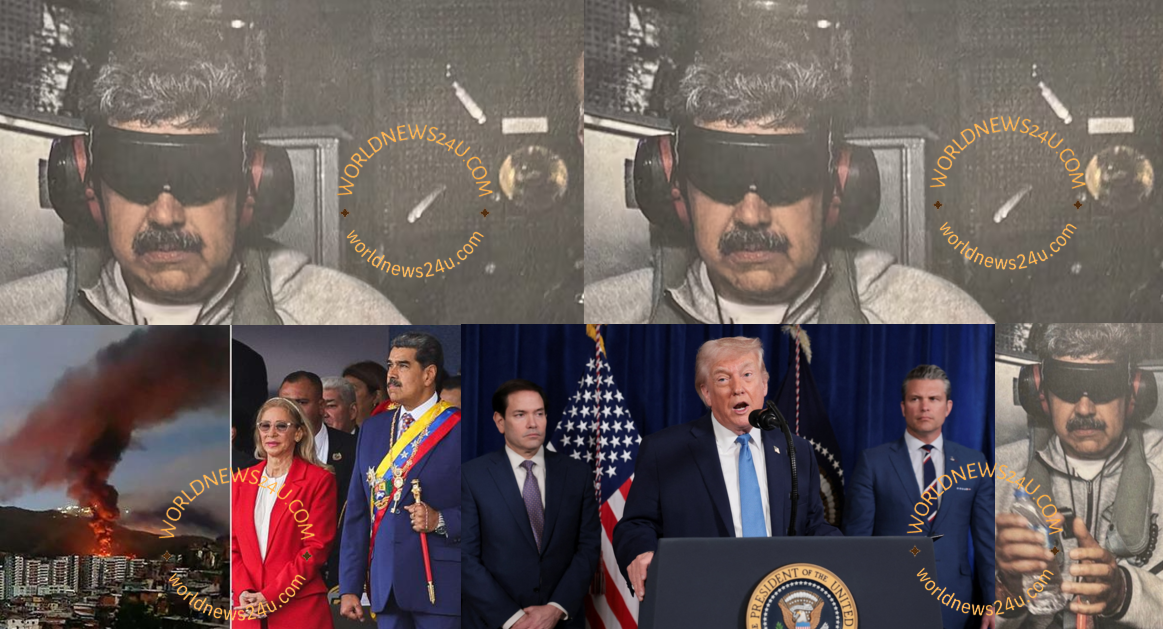
WASHINGTON: Late on Friday evening, January 2, and early this morning, at the direction of US President Donald Trump, the United States Armed Forces conducted a military operation in the capital of Venezuela. Trump himself announced this on Saturday at a press conference regarding the capture and arrest of Venezuelan President Nicolás Maduro.
About Operation Absolute Resolve
"Late yesterday evening and early this morning, at my direction, the United States Armed Forces conducted an extraordinary military operation in the capital of Venezuela, a display of overwhelming American military power," Trump said. "We used air, land, and sea forces to conduct a spectacular offensive. And it was an offensive the likes of which people have not seen since World War II."
"It was one of the most impressive, effective, and powerful demonstrations of American military power and professionalism in American history," Trump told reporters.
According to him, the operation to capture Maduro was flawless.
"All of Venezuela's military capabilities were overwhelmed. The men and women of our armed forces, working with U.S. law enforcement, successfully captured Maduro in the dead of night."
"It was dark. The lights of Caracas were largely out," Trump said vividly. "It was dark and dangerous."
"I will never allow terrorists and criminals to act against the United States with impunity," Trump said. "This resoundingly successful operation should serve as a warning to anyone who threatens American sovereignty or endangers American lives."
The nighttime operation to capture Maduro was named Operation Absolute Resolve, said General Dan Kaine, Chairman of the Joint Chiefs of Staff.
"The operation known as Operation Absolute Resolve was stealthy, precise, and conducted in the darkest hours of January 2nd, the culmination of months of planning and rehearsals—an operation that, frankly, only the United States Armed Forces could have carried out," he said.
Trump claimed he didn't notify lawmakers about the operation in advance because "Congress would inevitably leak information."
"This wasn't a mission that Congress could be notified about," Secretary of State Marco Rubio chimed in.
Military details on the operation
Dan Kane said Operation Absolute Resolve was the culmination of months of planning and rehearsals.
"We watched, we waited, we prepared. We remained patient and professional," he said. He added that the operation "involved more than 150 aircraft, flying over the Western Hemisphere in close coordination."
The force included F-22, F-35, F-18, EA-18, E-2 fighter jets, B-1 bombers, and other support aircraft, as well as numerous unmanned aerial vehicles.
"We arrived at Maduro's compound at 1:01 a.m. EST, or 2:01 a.m. local time in Caracas, and the detention force landed on Maduro's compound and moved quickly, precisely, and in a disciplined manner toward its target, isolating the area to ensure the safety of ground forces," Kaine said.
On Maduro's future in the US
Trump stated that Maduro and his wife will now face justice in the US. "Maduro and his wife will soon face the full weight of American justice and be tried on American soil," Trump said. "They are currently on a ship that will ultimately head to New York."
According to Trump, the strike crippled Venezuela's military capabilities, but the question remains whether these troops will be able to seize power in the apparent power vacuum that has emerged.
On the Governance of Venezuela
According to Trump, the United States will govern Venezuela. A task force will be established shortly to govern the country, and Secretary of State Marco Rubio has already spoken by phone with Venezuelan Vice President Delcy Rodriguez, who assumed power after Maduro's arrest and agreed to cooperate.
"We're there—and we'll remain there until there's a real transition of power," Trump said. "We'll essentially be running it."
Trump added that the U.S. military is prepared to launch a second, much more powerful wave of strikes against Venezuela if necessary, but that likely won't be necessary.
"We will govern this country until we can achieve a safe, orderly, and reasonable transition of power," Trump told reporters.
"We want peace, freedom, and justice for the great people of Venezuela, and that includes the many Venezuelans who now live in the United States and want to return to their country. This is their homeland," he continued. "We cannot allow Venezuela to be taken over by someone else who doesn't have the best interests of the Venezuelan people at heart. This has been going on for decades. We will not allow that."
"What happened to Maduro could happen to them," Trump said of Venezuela's political leadership if its representatives are not fair to their people.
Trump stated that Venezuelan opposition leader and Nobel laureate Maria Machado has no support in the country.
When asked to elaborate on how this would work, Trump said, "We're doing all of this right now. We're appointing people. We're talking to people. We're appointing different people. And we'll let you know who those people are."
He also stated that he was "not afraid" of having American troops on the ground if necessary.
"We need it. We had troops on the front lines last night, at a very high level. We're not afraid of that," he said.
On Venezuelan oil
Trump said Washington would maintain the embargo on Venezuelan oil supplies until all American demands were met, but did not specify what those demands were.
The US president also stated that American oil companies would enter Venezuela.
"As everyone knows, the oil business in Venezuela has been a complete failure for a long time. Oil production was practically zero compared to what could have been produced and what could have happened. "Now our largest American oil companies, the largest in the world, will invest billions of dollars, restore the severely damaged infrastructure, the oil infrastructure, and begin to generate profits for the country," he said, accusing the Venezuelan government of "stealing American oil."
"The United States built the oil industry in Venezuela, but the Venezuelan regime stole it from us. Washington lost billions of dollars," Trump assured, before concluding his speech and handing the floor over to Pentagon Secretary Pete Hegseth. Hegseth again praised the American military for the operation.
"Maduro had a chance, just as Iran had a chance, but he squandered it," Hegseth said. He asserted that the operation in Venezuela was aimed at ensuring the security and prosperity of the American people.
On relations with Russia
Trump stated that he does not foresee any difficulties between Russia and the United States over the operation in Venezuela, and did not discuss the capture of Maduro, who was considered close to Moscow, with Russian President Vladimir Putin.
On Maduro's illegitimacy
"Nicolas Maduro was indicted in the United States in 2020," said US Secretary of State Marco Rubio. "He is not the legitimate president of Venezuela. It's not just us saying that. The first Trump administration, the Biden administration, the second Trump administration. None of those three recognized him. He is not recognized by the European Union or many countries around the world."
Rubio also stated that Maduro is a fugitive from American justice and that a $50 million reward has been offered for his capture. "I think we saved $50 million," Rubio said, to which Trump interjected, "Don't let anyone else lay claim to that money. No one deserves it but us."
On the Monroe Doctrine
Trump's phrase, "We will manage this," will echo long after this press conference. The last time the US attempted this approach was when Paul Bremer was appointed to oversee Iraq following the overthrow of Saddam Hussein by American troops.
In his speech, Trump referenced the Monroe Doctrine—the idea that the US should have influence throughout the Western Hemisphere.
Trump declared that the 1823 Monroe Doctrine "is relevant again, and we will no longer ignore it." According to the doctrine, the US should not allow other countries to interfere in the affairs of the Americas.
"The Monroe Doctrine is a very important thing, but we have gone far, far beyond it," Trump said, specifying that it is now called the "Down-Rowe Doctrine."
"American dominance in the Western Hemisphere will never again be questioned. It won't happen," Trump declared, taking aim at Colombian President Gustavo Petro.
"He has cocaine dens. He has factories where he produces cocaine," Trump said. "And yes, I think I stand by my first statement... he really needs to watch his ass."
Trump and Secretary of State Marco Rubio also weighed in on whether tensions with Cuba could escalate.
Trump called Cuba an interesting case. "I think we'll be talking about Cuba because right now Cuba is a country that's failing, a very serious failure. And we want to help the people. It's very similar to the situation where we want to help the people in Cuba."
Add comment
Comments